

Mathematics-Online course: Preparatory Course Mathematics - Analysis - Differential Calculus
|
|
[home] [lexicon] [problems] [tests] [courses] [auxiliaries] [notes] [staff] |
|
|
Mathematics-Online course: Preparatory Course Mathematics - Analysis - Differential Calculus | ||
Babylonian Square Root Iteration | ||
| [previous page] [next page] | [table of contents][page overview] |
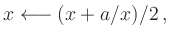
 ,
was already used by the Babylonians.
A closer look reveals the equivalence to Newton's method
applied to the function
,
was already used by the Babylonians.
A closer look reveals the equivalence to Newton's method
applied to the function
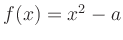 :
:
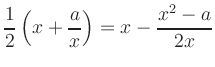
 and
and  we obtain the approximations
| 1 |
| 1.5 |
| 1.416666666666666666666666666666666666667 |
| 1.414215686274509803921568627450980392157 |
| 1.414213562374689910626295578890134910117 |
| 1.414213562373095048801689623502530243615 |
| 1.414213562373095048801688724209698078570 |
Apparently, the convergence is quite fast. With each step the number of correct digits (underlined) nearly doubles.
In this example, quadratic convergence can be proved directly by a simple algebraic manipulation:

The geometric interpretation of Newton's method shows that the iteration
is convergent for any

| [previous page] [next page] | [table of contents][page overview] |
| automatically generated 1/9/2017 |