

Mathematics-Online course: Preparatory Course Mathematics - Analysis - Differential Calculus
|
|
[home] [lexicon] [problems] [tests] [courses] [auxiliaries] [notes] [staff] |
|
|
Mathematics-Online course: Preparatory Course Mathematics - Analysis - Differential Calculus | ||
Newton's Method | ||
| [previous page] [next page] | [table of contents][page overview] |
 of a function
  numerically.
The sequence
numerically.
The sequence
 of the approximations to is obtained via
linearization, i.e.,
of the approximations to is obtained via
linearization, i.e.,
 is the intersection of the tangent to at
 with the
  -axis:

![\includegraphics[width=0.6\linewidth]{Newton_Verfahren.eps}](/inhalt/aussage/aussage3/img8.png)
For a simple zero
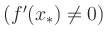 ,
Newton's iteration converges quadratically, i.e.,
,
Newton's iteration converges quadratically, i.e.,
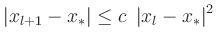
 is sufficiently close to .
| [previous page] [next page] | [table of contents][page overview] |
| automatically generated 1/9/2017 |