Mo logo [home] [lexicon] [problems] [tests] [courses] [auxiliaries] [notes] [staff] german flag

Mathematics-Online course: Prepcourse Mathematics - Basics - Propositional Logic

Quantifiers


[previous page] [next page] [table of contents][page overview]

The phrases
,,there exists ...``,    and     ,,for all ...``
are symbolically abbreviated by the existential quantifier $ \exists$ and the universal quantifier $ \forall$ respectively. These quantifiers are commonly used in the context of statements $ A(p)$ that depend on a parameter $ p$ in a set $ P$ .

Notation meaning
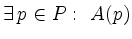
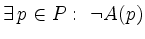
$ \exists\,p\in P:\ A(p)$ there is at least one $ p$ in $ P$, for which $ A(p)$ is true
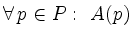
$ \forall\,p \in P:\ A(p)$ $ A(p)$ is true for all $ p$ in $ P$

Negation of statements turns existential quantifiers into universial quantifiers and vice versa:
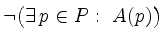
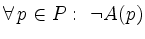
$\displaystyle \lnot\big( \exists\,p\in P:\ A(p) \big)$ $\displaystyle =$ $\displaystyle \forall\, p\in P:\ \lnot A(p)$  
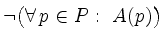
$\displaystyle \lnot\big( \forall\,p\in P:\ A(p) \big)$ $\displaystyle =$ $\displaystyle \exists\, p\in P:\ \lnot A(p)$  

The symbol $ \exists!$ is also commonly used to represent the phrase ,,there exists one and only one ...``.

(Authors: Höllig/Kimmerle/Abele)

As an illustration of the quantifier calculus let's consider the statement

$\displaystyle \forall\, \varepsilon>0\
\exists\, n_\varepsilon\
\forall\, n\in\mathbb{N}:\
n>n_\varepsilon \Longrightarrow \vert a_n\vert<\varepsilon
$

This means that the sequence

$\displaystyle a_1,a_2,\ldots
$

converges to 0, i.e. for every sufficiently large $ n$ the absolute value of $ a_n$ is less than any given bound $ \varepsilon$.

Negation is obtained by negating the main statement and replacing the quantifiers,

$\displaystyle \exists \leftrightarrow \forall
\,.
$

Substituting the implication and applying de Morgan's Laws we have

$\displaystyle \lnot(
n>n_\varepsilon \Longrightarrow \vert a_n\vert<\varepsilo...
...a_n\vert<\varepsilon
)=
n>n_\varepsilon \land \vert a_n\vert\ge\varepsilon
\,.
$

Finally, we obtain the negated statement

$\displaystyle \exists\,\varepsilon>0\
\forall\, n_\varepsilon\
\exists\, n\in\mathbb{N}:\
n>n_\varepsilon \land \vert a_n\vert\ge\varepsilon
\,.
$

This means that the sequence $ (a_n)$ does not converge to 0; that is there exists a value $ \varepsilon>0$, so that infinitely many terms of the sequence $ \vert a_n\vert$ are greater than $ \varepsilon$.
(Authors: Höllig/Abele)

[previous page] [next page] [table of contents][page overview]

  automatically generated 9/18/2007