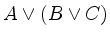
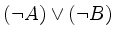
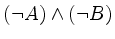
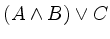
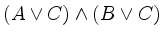
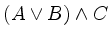
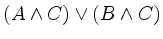
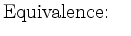
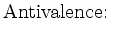
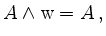
The following rules apply to logical operations:
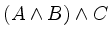
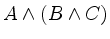
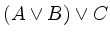
- Associative Laws:
- Commutative Laws:
- De Morgan's Laws:
- Distributive Laws:
- Further:
- Alternative representations:
These alternative representations are often used in proofs.
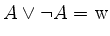
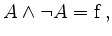
A logical formula, the truth value of which is independent from the truth values of the statements
involved, is called a tautology if it
is always true, or a contradiction if it is always false. Such a
formula may be replaced by t (also symbolized by  ) or f (also
symbolized by 0) respectively. In particular the following
identities hold:
) or f (also
symbolized by 0) respectively. In particular the following
identities hold:
(Authors: Höllig/Hörner/Abele)
(temporary unavailable)
(temporary unavailable)
(temporary unavailable)
| |
automatically generated
1/9/2017 |