
Mathematics-Online course: Linear Algebra - Basic Structures - Groups and Fields
|
|
[home] [lexicon] [problems] [tests] [courses] [auxiliaries] [notes] [staff] |
|
|
Mathematics-Online course: Linear Algebra - Basic Structures - Groups and Fields | ||
Fields | ||
| [previous page] [next page] | [table of contents][page overview] |
 together with two operations (addition and multiplication)
is called field if the following requirements (field axioms) are satisfied:
together with two operations (addition and multiplication)
is called field if the following requirements (field axioms) are satisfied:
 .
.
 so that
 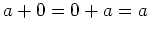 for all
 (zero element).
 there exists an element
  so that
 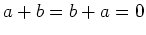 . Often
 is written instead of (inverse with respect to the addition).
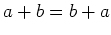 .
.
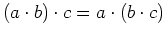 .
.
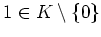 so that
 for all (identity element).
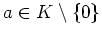 there is an element
  with
with
 (inverse with respect to the multiplication).
 .
.
 .
.
| automatically generated 4/21/2005 |