Mo logo [home] [lexicon] [problems] [tests] [courses] [auxiliaries] [notes] [staff] german flag

Mathematics-Online course: Linear Algebra - Basic Structures - Groups and Fields

Prime Fields


[previous page] [next page] [table of contents][page overview]

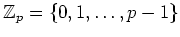
For every prime number $ p$ the set

$\displaystyle \mathbb{Z}_p = \{0,1,\ldots,p-1\}
$

forms a field under addition and multiplication modulo $ p$.
(Authors: Burkhardt/Höllig/Hörner)

Except for the existence of an inverse element all calculation rules for fields already hold true for integers and are inherited by their residue classes.

For $ a \in \{2,\ldots,p-1\}$ we can construct $ a^{-1}$ as follows: At first, observe that

$\displaystyle a^i \neq 0 \operatorname{mod} p \quad
\forall i \in \mathbb{N}\,
.
$

If we had $ a^i=np$, then it would follow that $ p$ would divide $ a$, which is impossible since $ a < p$. Now consider the sequence

$\displaystyle a^i \operatorname{mod} p,\quad i=0,\ldots,p-1\,
,
$

then one residue must occur at least twice, so that

$\displaystyle a^{i_1}=a^{i_2} \operatorname{mod} p\,,\quad
i_1<i_2\,
.
$

Thus we obtain

$\displaystyle a^{i_2-i_1}= a^{i_2-i_1-1}a = 1\operatorname{mod} p\,
,
$

and so we have found the inverse element for $ a$.


  automatically generated 4/21/2005