|
[home] [lexicon] [problems] [tests] [courses] [auxiliaries] [notes] [staff] |
|
|
Mathematics-Online course: Linear Algebra - Matrices - Linear Maps | ||
Linear Maps | ||
| [previous page] [next page] | [table of contents][page overview] |
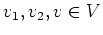
Let
be
-vector spaces. A map
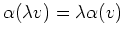
is called linear map, if for all
and
the following holds true:
The sum
and the vectors
form a triangle the shape of which remains unchanged
under rotation. That is, it does not matter whether
we form the sum before or after rotation.
It is evident that a dilatation by factor
commutes with any rotation.
In an anologous way we can illustrate that a reflection is also a linear mapping.
However, a translation of points in the plane is not linear. Neither additivity nor homogeneity are satisfied. For example, for
| Funktion | additivity | homogeneity |
|
|
X | X |
|
|
- | - |
|
|
X | X |
|
|
- | - |
|
|
X | X |
|
|
- | X |
Observe mapping
which assigns to each complex-valued function
the corresponding real part. This mapping is additive but not homogeneous.
Here we have
.
| automatically generated 4/21/2005 |