Mo logo [home] [lexicon] [problems] [tests] [courses] [auxiliaries] [notes] [staff] german flag

Mathematics-Online course: Linear Algebra - Basic Structures - Bases

Gram-Schmidt Method


[previous page] [next page] [table of contents][page overview]

Starting from a given basis $ b_1,\ldots,b_n$ we can construct an orthonormal basis $ u_1,\ldots,u_n$ as follows: We successively define
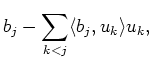
$\displaystyle \tilde u_j$ $\displaystyle =$ $\displaystyle b_j -
\sum_{k<j} \langle b_j,u_k \rangle u_k,$  
$\displaystyle u_j$ $\displaystyle =$ $\displaystyle \tilde u_j / \Vert\tilde u_j\Vert$  

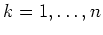
for $ k=1,\ldots,n$.

(Authors: App/Burkhardt/Höllig)


The vectors $ b_1=(1,2,2)^{\operatorname t}, b_2=(3,3,0)^{\operatorname t}, b_3=(9,0,0)^{\operatorname t}$ are linearly independent and, thus, form a basis of $ \mathbb{R}^3$. By means of the Gram-Schmidt procedure we obtain a corresponding orthonormal basis as follows:

$\displaystyle \tilde{u}_1$ $\displaystyle = b_1 = (1,2,2)^{\operatorname t}$    
$\displaystyle u_1$ $\displaystyle = \tilde{u}_1 / \Vert\tilde{u}_1\Vert = \frac{1}{3}(1,2,2)^{\operatorname t}$    
$\displaystyle \tilde{u}_2$ $\displaystyle =b_2 - \langle b_2, u_1 \rangle u_1 = (3,3,0)^{\operatorname t}- (1,2,2)^{\operatorname t}=
 (2,1,-2)^{\operatorname t}$    
$\displaystyle u_2$ $\displaystyle = \tilde{u}_2 / \Vert\tilde{u}_2\Vert = \frac{1}{3}(2,1,-2)^{\operatorname t}$    
$\displaystyle \tilde{u}_3$ $\displaystyle = b_3 - \langle b_3, u_1 \rangle u_1 - \langle b_3, u_2 \rangle
 u_2$    
  $\displaystyle = (9,0,0)^{\operatorname t}- (1,2,2)^{\operatorname t}- 2(2,1,-2)^{\operatorname t}= (4,-4,2)^{\operatorname t}$    
$\displaystyle u_3$ $\displaystyle = \tilde{u}_3 / \Vert\tilde{u}_3\Vert = \frac{1}{3}(2,-2,1)^{\operatorname t}\,.$    

(Authors: App/Burkhardt/Höllig)

  automatically generated 4/21/2005