
Mathematics-Online course: Linear Algebra - Basic Structures - Vector Spaces
|
|
[home] [lexicon] [problems] [tests] [courses] [auxiliaries] [notes] [staff] |
|
|
Mathematics-Online course: Linear Algebra - Basic Structures - Vector Spaces | ||
Linear Hull | ||
| [previous page] [next page] | [table of contents][page overview] |
 be a vector space.
The set of all linear combinations of vectors
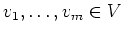 is called the linear hull of the vectors
  ;
notation:
;
notation:
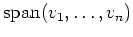 .
.
If
 , then the set of all linear combinations from
  is called linear hull of .
Linear hulls are subspaces.
| automatically generated 4/21/2005 |