Mo logo [home] [lexicon] [problems] [tests] [courses] [auxiliaries] [notes] [staff] german flag

Mathematics-Online course: Linear Algebra - Basic Structures - Vector Spaces

Linear Combinations


[previous page] [next page] [table of contents][page overview]

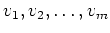
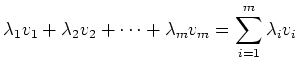
Given vectors $ v_1, v_2,\dots,v_m$ in a $ K$-vector space and given $ \lambda_i \in K$. A sum of the form

$\displaystyle \lambda_1 v_1 + \lambda_2 v_2 +\dots + \lambda_m v_m = \sum_{i=1}^m
\lambda_i v_i
$

is called a linear combination of the vectors $ v_i$.

More generally:

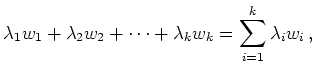
Let $ W \subset V$. A liner combination from $ W$ is a linear combination of a finite number of vectors from $ W$, that is, it is a finite sum of the form
$\displaystyle \lambda_1 w_1 + \lambda_2 w_2 + \dots + \lambda_k w_k = \sum_{i=1}^k
\lambda_i w_i \, ,
$

where $ w_i \in W$ and $ \lambda_i \in K$ für $ 1 \leq i \leq k$.

(Authors: App/Burkhardt/Kimmerle)

  1. In $ \mathbb{R}^3$ vector

    $\displaystyle v=(1,2,3)^{\operatorname t}$

    is a linear combination of vectors

    $\displaystyle v_1=(3,4,5)^{\operatorname t},\, v_2=(1,1,1)^{\operatorname t},$

    because

    $\displaystyle v=v_1-2v_2\,.$

  2. In $ \mathbb{R}^2$ vector

    $\displaystyle v=(1,0)^{\operatorname t}$

    is not a linear combination of vectors

    $\displaystyle v_1=(0,1)^{\operatorname t},\, v_2=(0,2)^{\operatorname t},$

    for any linear combination of $ v_1$ and $ v_2$ has the form $ (0,\ast)^{\operatorname t}$.

  3. In $ \mathbb{R}^4$ vector

    $\displaystyle v=(0,0,0,0)^{\operatorname t}$

    is a linear combination of vectors

    $\displaystyle v_1=(1,1,0,0)^{\operatorname t},\,
v_2=(0,2,2,0)^{\operatorname t},\,
v_3=(0,0,3,3)^{\operatorname t},\,
v_4=(4,0,0,4)^{\operatorname t},
$

    because

    $\displaystyle v=12 v_1- 6 v_2 + 4 v_3 - 3 v_4.$

(Authors: App/Burkhardt/Höllig)

  automatically generated 4/21/2005