Mo logo [home] [lexicon] [problems] [tests] [courses] [auxiliaries] [notes] [staff] german flag

Mathematics-Online course: Linear Algebra - Analytic Geometry - Orthogonal Groups

Decomposition


[previous page] [next page] [table of contents][page overview]

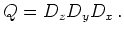
A rotation $ Q$ in $ \mathbb{R}^3$ can be composed of rotations about the coordinate axes:
$\displaystyle Q = D_z D_y D_x \,.
$

(Authors: Höllig/Reble/Höfert)

The rotation can be determined by eliminating the elements $ q_{21}, q_{31}, q_{32}$ of $ Q$ step by step:
$\displaystyle P_z^{-1}Q$ $\displaystyle =$ $\displaystyle \left(\begin{array}{ccc}
\star & \star & \star\\
0 & \star & \star\\
\star & \star & \star\\
\end{array}\right)$  
$\displaystyle P_y^{-1}P_z Q$ $\displaystyle =$ $\displaystyle \left(\begin{array}{ccc}
1 & \star & \star\\
0 & \star & \star\\
0 & \star & \star\\
\end{array}\right)$  
$\displaystyle P_x^{-1}P_y^{-1}P_z Q$ $\displaystyle =$ $\displaystyle \left(\begin{array}{ccc}
1 & \star & \star\\
0 & 1 & \star\\
0 & 0 & \star\\
\end{array}\right) = R \,.$  

One used the fact, that an arbitrary unit vector $ (v_1, v_2)^{\operatorname t}$ can be mapped onto $ (1,0)^{\operatorname t}$ by a rotation. For $ \operatorname{det} R = 1$ it follows $ r_{33} =1$ an for the columns are normed $ R$ has to be the unit matrix. This leads to the wanted representation.
(Authors: Höllig/Reble/Höfert)


  automatically generated 4/21/2005