

Mathematics-Online course: Linear Algebra - Analytic Geometry - Orthogonal Groups
|
|
[home] [lexicon] [problems] [tests] [courses] [auxiliaries] [notes] [staff] |
|
|
Mathematics-Online course: Linear Algebra - Analytic Geometry - Orthogonal Groups | ||
Rotation Axis and Angle | ||
| [previous page] [next page] | [table of contents][page overview] |
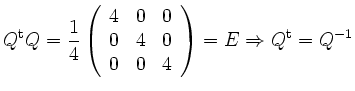
 in
in
 has an axis of rotation, i.e. fixes an unit vector
 , and corresponds to a plane rotation by an angle
  in the plane orthogonal to
.
in the plane orthogonal to
.
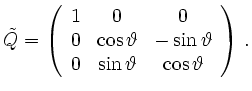
With respect to an orthonormal right-handed coordinate system  , the matrix
representation of is given by:
, the matrix
representation of is given by:
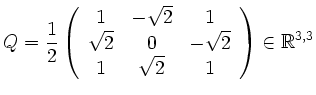
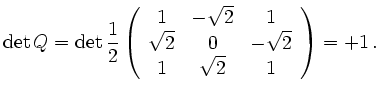
 to the eigenvalue
 :
:
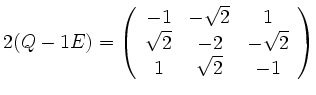
 1st row and 3rd row
  1st row you get
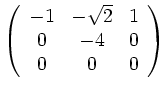
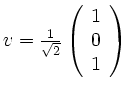 .
.
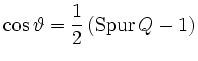
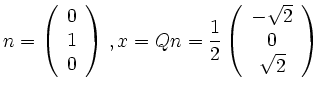
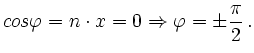
To compute  you compute the angle between an unit vector
  with
with  and the unit vector
  .
.
| automatically generated 4/21/2005 |