Mo logo [home] [lexicon] [problems] [tests] [courses] [auxiliaries] [notes] [staff] german flag

Mathematics-Online course: Linear Algebra - Normal Forms - Jordan Normal Form

Triangular Form


[previous page] [next page] [table of contents][page overview]

A square matrix $ A$ can be brought to upper triangle form by similarity transformations
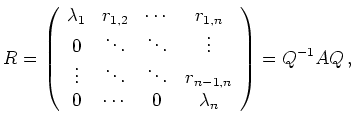
$\displaystyle R =
\left(\begin{array}{cccc}
\lambda_1 & r_{1,2} & \cdots & r_{...
..._{n-1,n} \\
0 & \cdots & 0 & \lambda_n
\end{array}\right)
=
Q^{-1} A Q\, ,
$

where the diagonal entries are the eigenvalues $ \lambda_i$ of $ A$.
(Authors: Burkhardt/Höllig/Hörner)

Starting with the trivial case of a $ (1\times1)$-matrix, we prove the assumption by induction on the dimension $ n$ of the matrix.

An $ (n\times n)$-matrix $ A$ has at least one eigenvalue and, hence, $ A$ has an eigenvector $ v$. Now, complete this vector to a basis $ \{v, w_1,\ldots ,w_{n-1}\}$. With respect to this basis mapping $ A$ has the representation

$\displaystyle \tilde{A} = T^{-1}AT=
\left(\begin{array}{cc}
\lambda & x\\
0 & B\\
\end{array}\right)\,.
$

$ B$ is an $ \big((n-1)\times (n-1)\big)$-matrix. By induction hypothesis there exists a transformation $ \tilde{Q}$ with $ \tilde{Q}^{-1}B\tilde{Q}=R_{n-1}$. With

$\displaystyle Q=T\left(\begin{array}{cc}
1 & 0\\
0 & \tilde{Q}
\end{array}\right)
$

it follows that
$\displaystyle Q^{-1}AQ$ $\displaystyle =$ $\displaystyle \left(\begin{array}{cc}
1 & 0\\
0 & \tilde{Q}^{-1}
\end{array}\right) T^{-1} A T
\left(\begin{array}{cc}
1 & 0\\
0 & \tilde{Q}
\end{array}\right)$  
  $\displaystyle =$ $\displaystyle \left(\begin{array}{cc}
1 & 0\\
0 & \tilde{Q}^{-1}
\end{array}\r...
...array}\right)
\left(\begin{array}{cc}
1 & 0\\
0 & \tilde{Q}
\end{array}\right)$  
  $\displaystyle =$ $\displaystyle \left(\begin{array}{cc}
1 & 0\\
0 & \tilde{Q}^{-1}
\end{array}\r...
...(\begin{array}{cc}
\lambda & x\tilde{Q}\\
0 & B\tilde{Q}\\
\end{array}\right)$  
  $\displaystyle =$ $\displaystyle \left(\begin{array}{cc}
\lambda & x\tilde{Q}\\
0 & \tilde{Q}^{-1...
...egin{array}{cc}
\lambda & x\tilde{Q}\\
0 & R_{n-1}\\
\end{array}\right)=
R\,.$  

(Authors: Burkhardt/Höllig/Hörner)

  automatically generated 4/21/2005