
Mo logo [home] [lexicon] [problems] [tests] [courses] [auxiliaries] [notes] [staff] german flag

Mathematics-Online course: Linear Algebra - Normal Forms - Diagonalisation

Rayleigh Quotient


[previous page] [next page] [table of contents][page overview]

Let $ S$ be a symmetric positive definite matrix. Then the extreme values of quotient
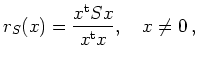
$\displaystyle r_S(x) = \frac{x^{\operatorname t}S x}{x^{\operatorname t}x},\quad x\ne 0\,
,
$

coincide with the smallest and the largest eigenvalue of $ S$.
(Authors: App/Burkhardt/Höllig)

The matrix $ S$ can be transformed into diagonal form by a unitary matrix $ U$:

$\displaystyle U^{\operatorname t}S U = \Lambda,\quad\lambda_i>0\,
.
$

Substituting $ S = U\Lambda U^{\operatorname t}$ and $ x = Uy$ we obtain

$\displaystyle r_S(y) =
\frac{y^{\operatorname t}\Lambda y}{y^{\operatorname t}...
...) y}
=\frac{\sum_i \lambda_i \vert y_i\vert^2}{\sum_i \vert y_i\vert^2}\,
.
$

This proves that

$\displaystyle \lambda_{\min} \le r_S(y) \le \lambda_{\max}\,
,
$

and we have equality for the corresponding eigenvectors $ x$.
(Authors: App/Burkhardt/Höllig)

  automatically generated 4/21/2005