

Mathematics-Online course: Preparatory Course Mathematics - Analysis - Functions
|
|
[home] [lexicon] [problems] [tests] [courses] [auxiliaries] [notes] [staff] |
|
|
Mathematics-Online course: Preparatory Course Mathematics - Analysis - Functions | ||
Compound Interest | ||
| [previous page] [next page] | [table of contents][page overview] |
 , a seed capital
  results after
  out-/incoming payments of
  (
( or .
or .  respectively) in
the final sum of
respectively) in
the final sum of
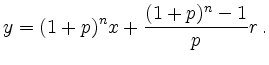
Here
 corresponds to an interest rate of
  , speaking in
annual rates.
, speaking in
annual rates.
With monthly interest calculation at an interest rate  , the
annual percentage rate
, the
annual percentage rate  calculates as

| [previous page] [next page] | [table of contents][page overview] |
| automatically generated 1/9/2017 |