Mo logo [home] [lexicon] [problems] [tests] [courses] [auxiliaries] [notes] [staff] german flag

Mathematics-Online course: Prepcourse Mathematics - Basics - Combinatorics

Pascal's Triangle


[previous page] [next page] [table of contents][page overview]

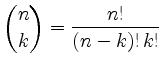
The binomial coefficients

$\displaystyle \binom{n}{k} = \frac{n!}{(n-k)!\,k!}
$

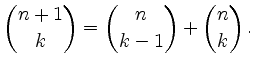
can be recursively calculated by

$\displaystyle \binom{n+1}{k} = \binom{n}{k-1} + \binom{n}{k}
\,.
$

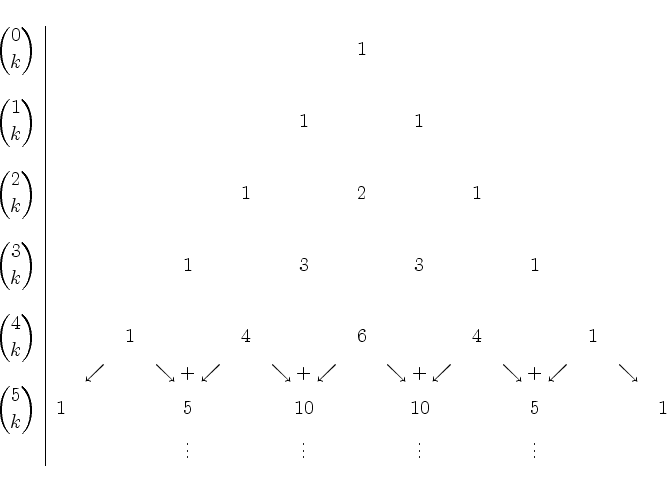
The recursion, known as Pascal's triangle, is illustrated in the figure.

\begin{center}
\begin{tabular}{c\vert cccccccccccccc}
$\displaystyle \binom{0}{k...
...dots$\ & & $\vdots$\ & & $\vdots$\ & & $\vdots$\ & \\
\end{tabular}\end{center}

(Authors: Höllig/Knesch/Abele)

The assertion

$\displaystyle \frac{(n+1)!}{(n+1-k)!\,k!} =
\frac{n!}{(n-k+1)!\,(k-1)!} +
\frac{n!}{(n-k)!\,k!}
$

reduces to the trivial identity

$\displaystyle n+1 = k + (n+1-k)
$

if we divide both sides by $ n!$ and multiply by $ (n-k+1)!\,k!$.
(Authors: Höllig/Knesch/Abele)

[previous page] [next page] [table of contents][page overview]

  automatically generated 10/23/2009