Mo logo [home] [lexicon] [problems] [tests] [courses] [auxiliaries] [notes] [staff] german flag

Mathematics-Online course: Prepcourse Mathematics - Linear Algebra and Geometry - Vector spaces

Linear Independence


[previous page] [next page] [table of contents][page overview]

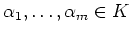
Vectors $ v_1,\dots,v_m$ in a $ K$-vector space are called linearly dependent, if there are $ \alpha_1,\dots,\alpha_m\in K$ so that
$\displaystyle \alpha_1 v_1 + \dots + \alpha_m v_m = 0
$

where at least one $ \alpha_i \neq 0$. Otherwise they are called linearly independent.

A subset $ M$ of $ V$ is called linearly independent, if any finite subset of $ M$ consists of linearly independent vectors. Otherwise $ M$ is said to be linearly dependent.

Abbreviations often used for linearly independentänd linearly dependentäre l. i.änd l. d.", resp.

(Authors: App/Burkhardt/Höllig/Kimmerle)

Observe that (in the sense of linear algebra) infinite sets $ M$ are admitted but only finite linear combinations can be formed. So, for example, in the vector space of sequences the set

$\displaystyle e=(1,1,\ldots)^{\operatorname t},\,
e_1=(1,0,0,\ldots)^{\operatorname t},\,
e_2=(0,1,0,\ldots)^{\operatorname t},\,
\ldots
$

is linearly independent, although (in a sense)

$\displaystyle e = \sum_{n\in\mathbb{N}}e_n\,
.
$

There is no finite representation of this constant sequence formed by the canonical unit vectors.

(Authors: App/Burkhardt/Höllig)

  1. Two vectors in $ \mathbb{R}^2$ are linearly independent if neither of them is a multiple of the other. For example, the vectors $ (1,0)^{\operatorname t}$ and $ (1,1)^{\operatorname t}$ are linearly independent, for the attempt

    $\displaystyle \lambda_1(1,0)^{\operatorname t}+$ $\displaystyle \lambda_2(1,1)^{\operatorname t}= 0$    

    yields


    $\displaystyle \lambda_2 =$ $\displaystyle \lambda_1 =0\,.$    

    However, the vectors $ (0,0)^{\operatorname t}$ and $ (2,3)^{\operatorname t}$ are linearly dependent because

    $\displaystyle (0,0)^{\operatorname t}=$ $\displaystyle 0(2,3)^{\operatorname t}$    

    and


    $\displaystyle 1(0,0)^{\operatorname t}+$ $\displaystyle 0(2,3)^{\operatorname t}= (0,0)^{\operatorname t}\,,
 \intertext{resp.}$    

  2. Three vectors $ u,v,w$ in $ \mathbb{R}^2$ are always linearly dependent, for the attempt

    $\displaystyle \lambda_1 u +$ $\displaystyle \lambda_2 v + \lambda 3 w = 0$    

    leads to an under-determined homogeneous LSE


    $\displaystyle \lambda_1 u_1 +$ $\displaystyle \lambda_2 v_1 + \lambda_3 w_1 = 0$    
    $\displaystyle \lambda_1 u_2 +$ $\displaystyle \lambda_2 v_2 + \lambda_3 w_2 = 0$    

    for $ \lambda_1, \lambda_2, \lambda_3$, which always has a non-trivial solution.
(Authors: App/Burkhardt/Höllig)

As in the two-dimensional case, two vectors in $ \mathbb{R}^3$ are linearly dependent if they are parallel, that is, if one of them is a multiple of the other one.

Three vectors are linearly dependent if two of them are parallel, or if one of them lies in the plane spanned by the other two vectors. For example, for

$\displaystyle u = (1,2,-3)^{\operatorname t},\,v = (4,-6,2)^{\operatorname t},\,w = (-9,3,6)^{\operatorname t}
$

we have $ 6u + 3v + 2w = (0,0,0)^{\operatorname t}$; hence, these vectors are linearly dependent.

According to the definition, the test for linear dependence leads to a homogeneous LSE

$\displaystyle \lambda_1
\left(\begin{array}{c}
x_1 \\ y_1 \\ z_1
\end{arra...
...d{array}\right)
=
\left(\begin{array}{c}
0 \\ 0 \\ 0
\end{array}\right)
$

for the scalars $ \lambda_i$. In particular, from this we see that four vectors in $ \mathbb{R}^3$ are always linearly dependent.

(Authors: App/Burkhardt/Höllig)

[previous page] [next page] [table of contents][page overview]

  automatically generated 10/23/2009
