Mo logo [home] [lexicon] [problems] [tests] [courses] [auxiliaries] [notes] [staff] german flag

Mathematics-Online course: Linear Algebra - Linear Systems of Equations - Approximation Problems

Normal Equation


[previous page] [next page] [table of contents][page overview]

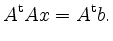
For an $ m \times n$ matrix $ A$ , any solution $ x$ of the least squares problem $ \Vert Ax-b\Vert _2$ satisfies the normal equations

$\displaystyle A^{\operatorname t}Ax = A^{\operatorname t}b.
$

\includegraphics[width=.4\moimagesize]{a_normalengleichungen}

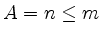
Geometrically, this means that the residuum $ Ax-b$ is orthogonal to the columns of $ A$ , i.e. to the subspace $ \operatorname{im} A$ of $ \mathbb{R}^m$ . The solution is unique if rank $ A = n \leq m$ .


From

$\displaystyle \Vert A(x+ty)-b\Vert _2^2 \ge \Vert Ax-b\Vert _2^2
$

and

$\displaystyle (Ax-b)^{\operatorname t}y = y^{\operatorname t}(Ax-b),\quad \Delta = Ax-b
$

it follows that

$\displaystyle 2ty^{\operatorname t}A^{\operatorname t}\Delta + t^2y^{\operatorname t}A^{\operatorname t}Ay\ge 0\,
$

for all $ t\in\mathbb{R}$ and $ y\in\mathbb{R}^n$ . If we interpret the left-hand side of the inequality as a parabola with respect to $ t$ , then it follows from the non-negativity that

$\displaystyle y^{\operatorname t}(A^{\operatorname t}\Delta)=0\,
.
$

This holds for all vectors $ y$ only if the expression in parentheses is the zero vector.

For the example

$\displaystyle A =
\left(\begin{array}{cc}
2 & 0 \\ 1 & 1 \\ 0 & 2
\end{array}\right),
\quad
b =
\left(\begin{array}{c}
0 \\ 3 \\ 0
\end{array}\right)
$

the normal equations

$\displaystyle \left(\begin{array}{cc}
5 & 1 \\ 1 & 5
\end{array}\right)
\lef...
..._2
\end{array}\right)
=
\left(\begin{array}{c}
3 \\ 3
\end{array}\right)
$

have the unique solution $ x = \left(\begin{array}{cc}
\frac{1}{2} & \frac{1}{2}
\end{array}\right)^{\operatorname t}
$ . The error is $ \Delta = (\begin{array}{ccc} 1 & -2 & 1
\end{array})^{\operatorname t}$ .

If $ A$ has linearly dependent columns, as in the example

$\displaystyle A =
\left(\begin{array}{cc}
2 & 2 \\ 1 & 1 \\ 0 & 0
\end{array...
...t),
\quad
b =
\left(\begin{array}{c}
0 \\ 3 \\ 0
\end{array}\right)\,
,
$

then the normal equations are singular:

$\displaystyle \left(\begin{array}{cc}
5 & 5 \\ 5 & 5
\end{array}\right)
\lef...
...end{array}\right)
=
\left(\begin{array}{c}
3 \\ 3
\end{array}\right)\,
.
$

In this case the solution

$\displaystyle x = \left(\begin{array}{c}
\dfrac{3}{10}+t \\ [+2ex]
\dfrac{3}{10}-t
\end{array}\right),\quad
t\in\mathbb{R}\,
,
$

is not unique, whereas the error $ \Delta = (\begin{array}{ccc}
\frac{6}{5} & -\frac{12}{5} & 0
\end{array})^{\operatorname t}$ is.
  automatically generated 4/21/2005