
Mathematics-Online course: Linear Algebra - Linear Systems of Equations - Approximation Problems
|
|
[home] [lexicon] [problems] [tests] [courses] [auxiliaries] [notes] [staff] |
|
|
Mathematics-Online course: Linear Algebra - Linear Systems of Equations - Approximation Problems | ||
Best Fitting Line | ||
| [previous page] [next page] | [table of contents][page overview] |
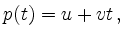
 ,
,
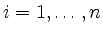 , can be determined
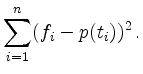
by minimizing the sum of the squares of the errors
, can be determined
by minimizing the sum of the squares of the errors
![\includegraphics[width=.7\moimagesize]{a_ausgleichsgerade}](/inhalt/aussage/aussage629/img5.png)
If we have at least two different  -coordinates,
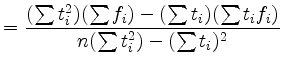
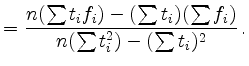
we obtain the following formulas
for the axis intercept
-coordinates,
we obtain the following formulas
for the axis intercept  and the slope
  :
:
 |
 |
|
 |
 |
| automatically generated 4/21/2005 |