Mo logo [home] [lexicon] [problems] [tests] [courses] [auxiliaries] [notes] [staff] german flag

Mathematics-Online course: Linear Algebra - Linear Systems of Equations - Classification and General Structure

Linear System of Equations


[previous page] [next page] [table of contents][page overview]

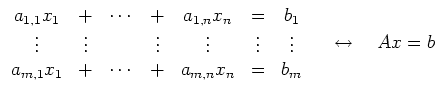
A linear system of equations (LSE) over a field $ K$ is given by

$\displaystyle \begin{array}{ccccccc}
a_{1,1}x_1 & + & \cdots & + & a_{1,n}x_n ...
... & + & a_{m,n}x_n & = & b_m
\end{array}
\quad \leftrightarrow \quad
Ax = b
$

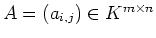
with coefficient matrix $ A = (a_{i,j})\in K^{m\times n}$, 'unknown' $ x\in K^n$ and right hand side $ b\in K^m$.

The LSE is called homogeneous if $ b = 0$. Otherwise it is called inhomogeneous.


A function $ f(x)$ can approximately be reconstructed from data

$\displaystyle (x_i,f_i),\quad i=1,\ldots,n
$

by interpolation. Using the linear attempt

$\displaystyle f(x) \approx p(x) = \sum_{j=1}^n c_j p_j(x)
$

with appropriate basis functions $ p_j$, the interpolation conditions

$\displaystyle f_i = p(x_i) = \sum_{j=1}^n c_j p_j(x_i),\quad
i=1,\ldots,n\,
$

yield the linear system of equations for $ c_j$

$\displaystyle Ac=b\,,
$

where $ a_{i,j}=p_j(x_i)$ and $ b_i=f_i$.

\includegraphics[width=\moimagesize]{b_interpolation}

In the pictured example of a leg of the Tour-de-France each data point is associated with an exponential function (red)

$\displaystyle p_i(x) = \exp\left(-\left(\frac{x-x_i}{10}\right)^2\right)\,.
$

By the strong decay of $ p_i$ as $ \vert x-x_i\vert\to\infty$ changes in data points have mainly local effects.
(Authors: App/Burkhardt/Höllig)

  automatically generated 4/21/2005