Mo logo [home] [lexicon] [problems] [tests] [courses] [auxiliaries] [notes] [staff] german flag

Mathematics-Online course: Linear Algebra - Matrices - Determinants

Expansion of Determinants


[previous page] [next page] [table of contents][page overview]

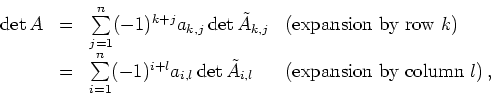
The determinant of an $ n\times n$-matrix $ A$ can be expanded by any row or column:

\begin{displaymath}
\begin{array}{rcll}
\operatorname{det} A &=&
\sum\limits...
...{i,l} &
(\text{expansion\ by\ column}\ l)\,
,
\end{array}
\end{displaymath}

where $ \tilde A_{i,j}$ denotes the matrix we obtain by deleting the $ i$-th row and the $ j$-th column of $ A$.
(Authors: Burkhardt/Höllig/Hörner)

Since $ \operatorname{det}A = \operatorname{det} A^{\operatorname t}$ it is sufficient to consider the expansion along a column.

We decompose the first column into

$\displaystyle a_l = \sum\limits_{i=1}^n a_{i,l}e_i\,,
$

then it follows from the multilinearity of the determinant

$\displaystyle \operatorname{det}A = \sum\limits_{i=1}^n a_{i,l} \operatorname{d...
...erbrace{
\left(a_1,\ldots,a_{l-1},e_i,a_{l+1},\ldots,a_n\right)
}_{=B_i}\,.
$

Now, consider matrix $ B_{i}$. By $ n-1$ interchanges of columns the first column becomes the last one and the other columns remain in the same order as before. In the same manner the $ i$-th row can become the last row by $ n-i$ interchanges of rows:

$\displaystyle \operatorname{det}B_{i}
=
(-1)^{n-l}(-1)^{n-i}\operatorname{det...
...i,1}& \cdots& a_{i,l-1}& a_{i,l+1}&\cdots &a_{i,n} & 1\\
\end{array}\right)
$

Expanding the determinant on the right hand side in a sum over permutations, we have to take into consideration only permutations $ \iota \in S_n$ with $ \iota_n=n$ (for other permutations the addends vanish). So we consider only the permutations of $ S_{n-1}$ and, thus,

$\displaystyle \operatorname{det}
\left(\begin{array}{rrrrrrr}
& & & & & & 0\\...
...dots &a_{i,n} & 1\\
\end{array}\right)=\operatorname{det}\tilde{A}_{i,l}\,.
$

Myltiplying the addends by $ 1=(-1)^{2l+2i-2n}$ yields the given expansion formula.

(Authors: Burkhardt/Höllig/Hörner)

Expanding the determinant of matrix

$\displaystyle A=\left(\begin{array}{rrr}
2 & 1 & 1\\
1 & 2 & 1\\
1 & 1 & 2
\end{array}
\right)
$

along the first row we obtain
$\displaystyle \operatorname{det}A$ $\displaystyle =$ $\displaystyle (-1)^2\cdot 2 \operatorname{det}\left(\begin{array}{rr}2 &
1\\ 1 & 2\end{array}\right)$  
  $\displaystyle +$ $\displaystyle (-1)^3\cdot 1 \operatorname{det}\left(\begin{array}{rr}1 &
1\\ 1 & 2\end{array}\right)$  
  $\displaystyle +$ $\displaystyle (-1)^4\cdot 1 \operatorname{det}\left(\begin{array}{rr}1 &
2\\ 1 & 1\end{array}\right)$  
  $\displaystyle =$ $\displaystyle 2(4-1)-1(2-1)+1(1-2)=6-1-1=4\,.$  

(Authors: Burkhardt/Höllig/Hörner)

  automatically generated 4/21/2005