For some special types of
-matrices
the
determinant can be given immediately.
- (i)
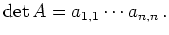
- Triangular matrices:
If
for
or
, then we can
calculate the determinant by
- (ii)
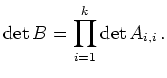
- Block-diagonal matrices:
If matrix
has a blocked structure with
,
and square diagonal blocks, then we have
- (iii)
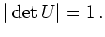
- For a unitary matrix
we have
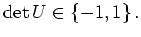
In particular, for orthogonal matrices
we have
(Authors: Burkhardt/Höllig/Hörner)
- (i)
- Since
it is sufficient to consider upper triangle matrices.
Let
be a permutation of
wich is not the identity.
Then, there exists at least one element
with
, hence
we have
.
Thus, by the expansion of the determinant in a sum over permutations,
this sum reduces to one addend which corresponds to the identity
permutation and, hence, is the product of the diagonal entries.
- (ii)
- At first, consider a decomposition in only two
diagonal blocks of dimensions
and
.
Then, taking the sum over all permutations we see that we
have to take into consideration only that permutations which
permute the first
elements among each other and, consequently,
permute the last
elements among each other as well. The addends
corresponding to other permutations vanish.
Thus, each remaining addend decomposes into a product
of a permutation
of the first
elements and a product
of a permutation
of the last
elements as follows:
For more than two diagonal blocks the corresponding statements
can be proved by induction.
- (iii)
- Since complex conjugation is a operation which commutes with the
arithmetical operations of addition and multiplication, and since
,
it follows from the multiplicativity of determinants that
In the real case the determinant is real and, hence,
and
are the only values that can be attained.
(Authors: Burkhardt/Höllig/Hörner)
| |
automatically generated
4/21/2005 |