Mo logo [home] [lexicon] [problems] [tests] [courses] [auxiliaries] [notes] [staff] german flag

Mathematics-Online course: Linear Algebra - Matrices - Determinants

Determinant as Antisymmetric Multilinear Form


[previous page] [next page] [table of contents][page overview]

The determinant

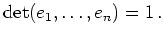
$\displaystyle \operatorname{det} A =
\operatorname{det}(a_1,\ldots,a_n)
$

of a square matrix $ A$ with columns $ a_j$ can be defined by the following properties: By the properties given above a determinant can be expanded into a sum of $ n$-fold products:

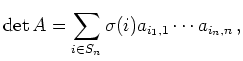
$\displaystyle \operatorname{det}A =
\sum_{i \in S_n} \sigma(i)
a_{i_1,1}\cdots a_{i_n,n}\,
,
$

where summation goes over all permutations $ (i_1,\ldots,i_n)$ of $ (1,\ldots,n)$ and $ \sigma$ denotes the sign of the permutation.

The following notation is also used:
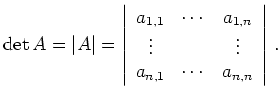
$\displaystyle \operatorname{det} A =
\vert A\vert =
\left\vert\begin{array}...
...vdots & & \vdots \\
a_{n,1} & \cdots & a_{n,n}
\end{array}\right\vert\,
.
$

(Authors: Burkhardt/Höllig/Hörner)

Because of the high number of addends (there exist $ n!$ permutations) the explicit representation of the determinant is not suitable for practical calculations. But this representation is closely connected with the defining properties of the determinant and is used to prove some further properties. Therefore this representation was given as an equivalent definition.

At first we show that the required properties necessarily lead to the expansion of the determinant by means of permutations. For that puropose we represent the columns of $ A$ as linear combination of unit vectors $ e_i$:

$\displaystyle a_j = \sum_{i=1}^n a_{i,j} e_{i}\,
.
$

Because of multilinearity we obtain

$\displaystyle \operatorname{det} A = 
 \sum_{i_1=1}^n \cdots \sum_{i_n=1}^n 
 a...
...} 
 \underbrace{
 \operatorname{det}(e_{i_1},\ldots,e_{i_n}) 
 }_{=:d_i}
 \,
 .$    

We can simplify this sum as follows: If we find at least twice the same unit vector in different columns, then, $ d_i$ equals zero because of antisymmetry:

$\displaystyle \operatorname{det}(\ldots,e_k,\ldots,e_k,\ldots) =
-\operatorname{det}(\ldots,e_k,\ldots,e_k,\ldots)\,
.
$

If all $ i_\nu$ are pairwise different, that is, if

$\displaystyle (i_1,\ldots,i_n)
$

is a permutation of $ (1,\ldots,n)$, then we obtain

$\displaystyle d_i = (-1)^{\tau(i)}\,
,
$

where $ \tau(i)$ is the number of interchanges necessary to rearrange the unit vectors in their canonical order. Observe that this number of interchanges is uniquely determined modulo $ 2$. According to the definition of the sign of a permutation we have

$\displaystyle \operatorname{det}(e_{i_1},\ldots,e_{i_n}) =
\sigma(i) \operatorname{det}(e_1,\ldots,e_n) =
\sigma(i)\,
,
$

that is, we obtain the given expansion.

Conversely, we verify that the expansion satisfy the required determinant rules. Multilinearity holds true since in the products

$\displaystyle a_{i_1,1}\cdots a_{i_n,n}\,
$

exactly one entry of each column occurs. Antisymmetry follows from the fact that the interchange of two columns leads to a change by $ 1$ of the number of interchanges necessary to rearrange the factors of each addend in canonical order. Finally, for the unit matrix the sum reduces to the only addend $ a_{1,1}\cdots a_{n,n}=1\cdots1=1$.
(Authors: Burkhardt/Höllig/Hörner)

  automatically generated 4/21/2005