
Mathematics-Online course: Linear Algebra - Basic Structures - Groups and Fields
|
|
[home] [lexicon] [problems] [tests] [courses] [auxiliaries] [notes] [staff] |
|
|
Mathematics-Online course: Linear Algebra - Basic Structures - Groups and Fields | ||
Transposition and Sign of Permutations | ||
| [previous page] [next page] | [table of contents][page overview] |
A transposition

 and
and  . By composition of these elementary
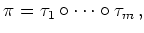
permutations, any permutation
. By composition of these elementary
permutations, any permutation  can be represented by:
 ) is uniquely determined.
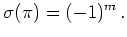
Thus, the so called sign of permutation is
well defined by
) is uniquely determined.
Thus, the so called sign of permutation is
well defined by
| automatically generated 4/21/2005 |