Mo logo [home] [lexicon] [problems] [tests] [courses] [auxiliaries] [notes] [staff] german flag

Mathematics-Online course: Linear Algebra - Matrices - Special Matrices

Fourier Matrices


[previous page] [next page] [table of contents][page overview]

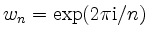
Raising the root of unity

$\displaystyle w_n = \exp(2\pi\mathrm{i}/n)
$

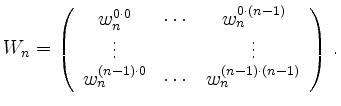
to higher powers we obtain the so called Fourier matrix

$\displaystyle W_n =
\left(\begin{array}{ccc}
w_n^{0\cdot 0} & \cdots & w_n^{0 ...
...
w_n^{(n-1) \cdot 0} & \cdots & w_n^{(n-1)\cdot (n-1)}
\end{array}\right)\,
.
$

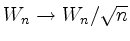
Normalizing ( $ W_n \to W_n/\sqrt{n}$) yields a unitary matrix.
(Authors: App/Burkhardt/Höllig)

The orthogonality of the columns can easily be verified. The (complex) scalar product of the $ (j+1)$-th and the $ (k+1)$-th basis vector yields

$\displaystyle \sum_{\ell=0}^{n-1}
w_n^{\ell j} \overline{w_n^{\ell k}} =
\sum_\ell w_n^{(j-k)\ell} =
\frac{w_n^{(j-k)n} - 1}{w_n^{j-k}-1}\,
,
$

and the numerator equals zero since $ w_n^n=1$.
(Authors: App/Burkhardt/Höllig)

For $ n=4$ we have $ w_4 = \exp(2\pi\mathrm{i}/4)=\mathrm{i}$, and we obtain

$\displaystyle W_4 =
\left(\begin{array}{cccc}
1 & 1 & 1 & 1 \\
1 & \mathrm...
... & -1 & 1 & -1 \\
1 & -\mathrm{i} & 1 & \mathrm{i}
\end{array}\right)\,
.
$

(Authors: App/Burkhardt/Höllig)

  automatically generated 4/21/2005