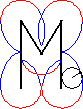
For an
-matrix
the maximal
number of linearly independent columns
equals the maximal number of linearly independent
rows. This number is called rank of
and is
denoted by
.
The maximal number of linearly independent colums
corresponds to the dimension of the
vector space
since a basis can be selected from the columns.
An analogous statement holds true for the
vector space
spanned by the rows
.
The assertion
will now be proved by induction on
.
It can easily be seen that
and
remain unchanged under the following operations:
- Permutation of columns or rows;
- Addition of a scalar multiple of a column (row)
to another column (row).
If matrix
then, by the operations
given above, this matrix can be brought to
the form
At first we achieve
by permutations.
Then the remaining elements of the first row and column
are nullified by appropriate additions.
More precisely, we add the
-fold
of the first column to the
-th column (
)
and then we proceed with the rows in an analogous way.
Let
and
denote the respective vector spaces for the
-matrix
, then we obtain
and the assertion follows by induction.
(Authors: Burkhardt/Höllig/Hörner)
Some typical cases are illustrated by means
of three
-matrices:
For the third matrix we have
for the columns
and
,
and
for the rows
and
. Thus in either case
the dimension of the corresponding vector space equals 1.
(Authors: Burkhardt/Höllig/Hörner)
| |
automatically generated
4/21/2005 |