Mo logo [home] [lexicon] [problems] [tests] [courses] [auxiliaries] [notes] [staff] german flag

Mathematics-Online course: Linear Algebra - Matrices - Matrix Operations

Matrix Multiplication


[previous page] [next page] [table of contents][page overview]

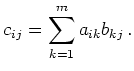
The product of two matrices $ A \in K^{n \times m}$ and $ B \in K^{m \times s}$ is the $ (n \times s)$-Matrix $ AB := (c_{ij})$ defined by

$\displaystyle c_{ij} = \sum_{k=1}^m a_{ik}b_{kj}\, .
$

The product is defined only if the number of columns of $ A$ equals the number of rows of $ B$.

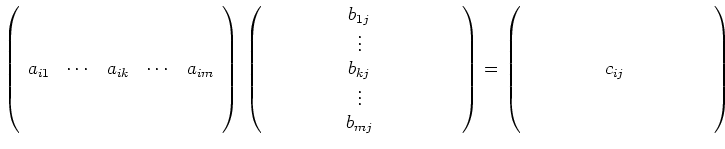
We can interpret the matrix product as follows: The element $ c_{ij}$ of product matrix $ (c_{ij}) = AB$ is the ,,scalar product`` of the $ i$-th row vector of $ A$ and the $ j$-th column vector of $ B$:

$\displaystyle \left(
\begin{array}{ccccc}
& & \vphantom{b_{1j}} & & \\
& & ...
...& \vphantom{\vdots} & & \\
& & \vphantom{b_{mj}} & &
\end{array}
\right)
$

Matrix multiplication corresponds to composition of linear maps

$\displaystyle \alpha: u \mapsto v=Bu,\quad
\beta: v \mapsto w=Av\,
,
$

that is, $ C$ is the matrix representation of $ \beta\circ\alpha$.


Connection with the composition of linear maps

For the composition of the maps defined by

$\displaystyle w_i = \sum_{k=1}^m a_{ik} v_k,\quad
v_k = \sum_{j=1}^s b_{kj} u_j
$

we obtain

$\displaystyle w_i =
\sum_k \sum_j a_{ik} b_{kj} u_j =
\sum_j \left[ \sum_k a_{ik} b_{kj} \right] u_j\,
.
$

The expression in square brackets is the matrix product and, thus, gives the matrix representation $ C$ of the composition of the two maps.

(Authors: Burkhardt/Höllig/Hörner)

$\displaystyle \left(\begin{array}{rrr}
1 & 10 & 100 \\
100 & 10 & 1
\end{ar...
...{array}{rrr}
321 & 213 & 132 \\
123 & 312 & 231 \\
\end{array}
\right)
$

$\displaystyle \left(\begin{array}{r}
1\\ 2\\ 3
\end{array}
\right)
\left(\...
...ft(\begin{array}{rr}
7 & 13 \\
14 & 26 \\
21 & 39
\end{array}
\right)
$

$\displaystyle \left(\begin{array}{rr}
3 & 4
\end{array}
\right)
\left(\begin{array}{r}
3\\ 4
\end{array}
\right) = 25
$

$\displaystyle \left(\begin{array}{rr}
1 & \mathrm{i} \\
\mathrm{i} & 1
\en...
...
\right) =
\left(\begin{array}{r}
0 \\
2\mathrm{i}
\end{array}
\right)
$

(Authors: Burkhardt/Höllig/Hörner)

  automatically generated 4/21/2005