
Mathematics-Online course: Linear Algebra - Matrices - Linear Maps
|
|
[home] [lexicon] [problems] [tests] [courses] [auxiliaries] [notes] [staff] |
|
|
Mathematics-Online course: Linear Algebra - Matrices - Linear Maps | ||
The dimensions of Image and Kernel | ||
| [previous page] [next page] | [table of contents][page overview] |
 be a linear map and
let
be a linear map and
let
 .
Then the following holds true:
.
Then the following holds true:
 is a subspace of
  .
.
 is a subspace of
  .
.

 -th derivative on the
space of polynomials of degree
-th derivative on the
space of polynomials of degree  .
.
At first, let  and
and  .
For the space of polynomials of degree
.
For the space of polynomials of degree  the monomials
 form a basis. Hence, the space has the dimension 3.
For
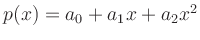 the polynomial
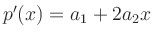 has degree
  . Thus, the image space has dimension 2.
The derivative of a constant vanishes, and the constants
form a one-dimensional subspace. Hence, the kernel of the mapping
has dimension 1 and the dimension formula is satisfied by  .
.
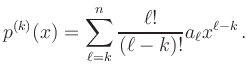
In general a polynomial has the form
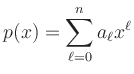 -th derivative has the form
 and
polynomials of degree
and
polynomials of degree  are nullified.
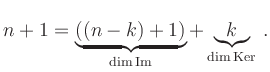
Thus, the dimension formula reads as follows:
are nullified.
Thus, the dimension formula reads as follows:
| automatically generated 4/21/2005 |