Mo logo [home] [lexicon] [problems] [tests] [courses] [auxiliaries] [notes] [staff] german flag

Mathematics-Online course: Linear Algebra - Basic Structures - Bases

Orthogonal Basis


[previous page] [next page] [table of contents][page overview]

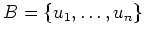
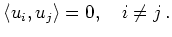
A given basis $ B = \{u_1,\dots,u_n\}$ is called orthogonal if

$\displaystyle \langle u_i,u_j \rangle = 0,\quad i \neq j\,
.
$

If all basis vectors are unit vectors, that is $ \vert u_i\vert = 1$, then $ B$ is called orthonormal system or orthonormal basis.

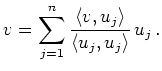
A vector $ v$ has the following representation relative to a given orthogonal basis $ u_1,\ldots,u_n$:

$\displaystyle v = \sum_{j=1}^n
\frac{\langle v,u_j\rangle}{\langle u_j,u_j\rangle}\,
u_j\,
.
$

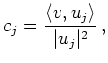
For the coefficients

$\displaystyle c_j = \frac{\langle v,u_j\rangle}{\vert u_j\vert^2}\,
,
$

we have

$\displaystyle \vert c_1\vert^2 \vert u_1\vert^2 + \cdots + \vert c_n\vert^2 \vert u_n\vert^2
= \vert v\vert^2\,
.
$

For a orthonormal basis the denominators equal one and this leads to

$\displaystyle c_j = \langle v,u_j\rangle\,,\quad
\vert c_1\vert^2 + \cdots + \vert c_n\vert^2 = \vert v\vert^2\,.
$

(Authors: App/Burkhardt/Höllig/Kimmerle)

Since $ u_1,\ldots,u_n$ form a basis there exist $ \lambda_1,\ldots,\lambda_n$ in $ K$ with

$\displaystyle v = \sum_{j=1}^n \lambda_j u_j\,.
$

Taking the scalar product with $ u_k$ in the above equation and using orthogonality of the basis we obtain

$\displaystyle \langle v, u_k\rangle =$ $\displaystyle \lambda_k \langle u_k, u_k \rangle$    

and


$\displaystyle \lambda_k =$ $\displaystyle \frac{\langle v, u_k\rangle}{\langle u_k, u_k \rangle}\,.$    

The identity for the coefficients is a generalisation of the Pyhtagorean theorem ($ n=2$). It follows directly from

$\displaystyle \vert v\vert^2 = \langle c_1 u_1 + \cdots + c_n u_n,
c_1 u_1 + \cdots + c_n u_n \rangle
$

by factoring out, if we take into consideration that mixed terms

$\displaystyle \langle c_j u_j , c_k u_k \rangle,\quad j\ne k
$

vanish because of the orthogonality of the basis vectors.
(Authors: App/Burkhardt/Höllig)

  1. Vector $ v=(2,1)^{\operatorname t}$ has the following representation with respect to the orthonormal basis $ u_1=\frac{1}{5}(3,4)^{\operatorname t}, u_2=\frac{1}{5}(4,-3)^{\operatorname t}$:

    $\displaystyle v$ $\displaystyle = \langle v, u_1\rangle u_1 + \langle v,u_2\rangle u_2$    
      $\displaystyle = 2u_1 - u_2\,.$    

  2. Vector $ v=(-1,1,3)^{\operatorname t}$ has the following representation with respect to the orthonormal basis $ u_1=\frac{1}{9}(1,4,8)^{\operatorname t},
u_2=\frac{1}{9}(4,7,-4)^{\operatorname t}, u_3=\frac{1}{9}(8,-4,1)^{\operatorname t}$:

    $\displaystyle v$ $\displaystyle = \langle v, u_1\rangle u_1 + \langle v,u_2\rangle u_2 + \langle v,
 u_1\rangle u_1$    
      $\displaystyle = 3u_1 -u_2 -u_3\,.$    

(Authors: App/Burkhardt/Höllig)

  automatically generated 4/21/2005