
Mathematics-Online course: Linear Algebra - Basic Structures - Bases
|
|
[home] [lexicon] [problems] [tests] [courses] [auxiliaries] [notes] [staff] |
|
|
Mathematics-Online course: Linear Algebra - Basic Structures - Bases | ||
Basis | ||
| [previous page] [next page] | [table of contents][page overview] |
 of vector space
  is called
basis of , if is linearly independent
as well as a generating system for , that is,
any vector
is called
basis of , if is linearly independent
as well as a generating system for , that is,
any vector  has a unique representation
as finite linear combination
has a unique representation
as finite linear combination
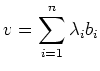
 .
.
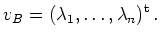
In a finite-dimensional vector space any vector can be described by its coordinates relative to a given basis:
In an infinite-dimensional vectorspace a generating system  is a basis if and only if any finite subset of consists of
linearly independent vectors.
is a basis if and only if any finite subset of consists of
linearly independent vectors.
| automatically generated 4/21/2005 |