Mo logo [home] [lexicon] [problems] [tests] [courses] [auxiliaries] [notes] [staff] german flag

Mathematics-Online course: Linear Algebra - Basic Structures - Scalar Product and Norm

Angles


[previous page] [next page] [table of contents][page overview]

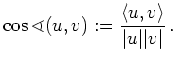
For a real scalar product an angle in $ [0,\pi]$ between $ u$ and $ v$ is defined by

$\displaystyle \cos\sphericalangle(u,v) :=
\frac{\langle u,v\rangle}{\vert u\vert\vert v\vert}\, .
$


The definition of angle is motivated by the law of cosines for vectors in $ \mathbb{R}^2$:

\includegraphics[width=7cm]{cosinussatz}

In a triangle the following relation holds true for the lenghts of its sides:

$\displaystyle c^2=a^2+b^2-2ab\cos\left(\angle (AOB)\right)\,.
$

On the other hand, since according to the definition of the scalarproduct

$\displaystyle \left\vert\overrightarrow{OA}-\overrightarrow{OB}\right\vert^2 = ...
...t^2 -
2\left\langle\overrightarrow{OA},\overrightarrow{OB}\right\rangle\,
,
$

the definition of angle results from comparison.

By the Cauchy-Schwarz inequality we obtain for any scalar product

$\displaystyle \frac{\langle u,v \rangle}{\vert u\vert \vert v\vert} \in [-1,1]\,
.
$

Thus we can equate the value of the quotient with the cosine of an angle in $ [0,\pi]$.

(Authors: Burkhardt/Höllig/Hörner)

  automatically generated 4/21/2005