Mo logo [home] [lexicon] [problems] [tests] [courses] [auxiliaries] [notes] [staff] german flag

Mathematics-Online course: Linear Algebra - Basic Structures - Scalar Product and Norm

Scalar Product of Real Vectors


[previous page] [next page] [table of contents][page overview]

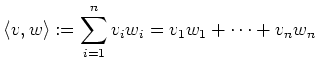
For vectors $ v = (v_1,\dots,v_n), w = (w_1,\dots,w_n) \in \mathbb{R}^n$ the scalar product is defined by

$\displaystyle \langle v,w \rangle := \sum_{i=1}^n v_i w_i = v_1w_1 + \dots + v_nw_n
$

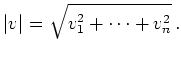
and the associated norm is

$\displaystyle \vert v\vert = \sqrt{v_1^2 + \dots + v_n^2}\,
.
$

\includegraphics{Def_Skalarprod.eps}

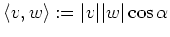
Geometrically the scalar product can be defined by
$\displaystyle \langle v,w \rangle := \vert v\vert\vert w\vert\cos \alpha
$

where $ \alpha$ is the smaller one of the two angles between $ v$ and $ w$. That is, the scalar product is the oriented length of the projection of one vector onto the other one multiplied by the magnitude of the vector onto which the former was projected.


The properties of the scalar product can easily be verified.

We can verify (first of all for $ n = 2$) the equivalence to the geometric definition by the law of cosines.

Let $ v = (v_1,v_2)$ and $ w = (w_1,w_2)$, then according to the law of cosines

$\displaystyle \vert v - w\vert^2 = \vert v\vert^2 + \vert w\vert^2 - 2 \vert v\vert \vert w\vert \cos \alpha .$

By inserting we obtain

$\displaystyle (v_1 - w_1)^2 + (v_2 - w_2)^2 = v_1^2 + v_2 ^2 + w_1^2 + w_2^2 - 2 \vert v\vert \vert w\vert
\cos \alpha .$

By transforming this equation the assertion follows.

For $ n \geq 2$ the vectors $ v$ and $ w$ span a plane in $ \mathbb{R}^n$. The corresponding calculation in this plane shows that the assertion holds true for any dimension $ n \geq 2$.

Physical Interpretation: The work done by a constant force $ F$ along a straight line segment described by vector $ s$ is given by the scalar product $ \langle F,s \rangle$.

(Authors: Burkhardt/Höllig/Hörner)

  automatically generated 4/21/2005