Mo logo [home] [lexicon] [problems] [tests] [courses] [auxiliaries] [notes] [staff] german flag

Mathematics-Online course: Linear Algebra - Basic Structures - Scalar Product and Norm

Scalar Product


[previous page] [next page] [table of contents][page overview]

A scalar product in a real (complex) vector space $ V$ is a map

$\displaystyle \langle \cdot, \cdot \rangle:\, V\times V \to
\mathbb{R}\ (\mathbb{C})
$

having the following properties:
S1
$ \langle v,v \rangle > 0$ für $ v\ne 0$
S2
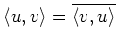
$ \langle u,v \rangle =
\overline{\langle v,u\rangle}$
S3
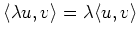
$ \langle \lambda u, v \rangle =
\lambda \langle u, v \rangle$
S4
$ \langle u+v, w \rangle =
\langle u,w\rangle + \langle v,w\rangle$
for all $ u,v,w\in V$ and $ \lambda\in\mathbb{R}\
(\mathbb{C})$.
(Authors: Burkhardt/Höllig/Kreitz)

In the real case the scalar product is symmetric:

$\displaystyle \langle u,v \rangle = \langle v,u\rangle
\in\mathbb{R}\,
.
$

Then, the proerties S3 and S4 imply linearity in the second argument too:

$\displaystyle \langle w , \alpha u + \beta v \rangle =
\alpha \langle w , u \rangle +
\beta \langle w , v \rangle
$

for $ \alpha,\beta\in\mathbb{R}$. Whereas in the complex case we have

$\displaystyle \langle w , \alpha u + \beta v \rangle =
\bar\alpha \langle w , u \rangle +
\bar\beta \langle w , v \rangle\,
.
$

The asymmetry resulting from property S2 is necessary to ensure the positivity of the complex scalar product. For example, we have

$\displaystyle \langle \mathrm{i} v, \mathrm{i} v \rangle \ne
\mathrm{i}^2 \langle v, v \rangle =
- \langle v, v \rangle < 0
$

for $ v\ne 0$. In fact the following holds true:

$\displaystyle \langle \mathrm{i} v, \mathrm{i} v \rangle =
(\mathrm{i}\bar{\mathrm{i}}) \langle v, v \rangle =
\langle v, v \rangle\,
.
$

The positivity required by S1 is important to define a norm by

$\displaystyle \vert v\vert = \sqrt{\langle v, v\rangle}\,.
$

(Authors: Burkhardt/Höllig/Hörner)


  automatically generated 4/21/2005