Mo logo [home] [lexicon] [problems] [tests] [courses] [auxiliaries] [notes] [staff] german flag

Mathematics-Online course: Linear Algebra - Basic Structures - Vector Spaces

Vector Space


[previous page] [next page] [table of contents][page overview]

Let $ K$ be a field. An Abelian group $ (V,+)$ is called $ K$-vector space (vector space over $ K$) if a scalar multiplication ,,$ \cdot$`` is defined so that for all $ \lambda$, $ \lambda_1$, $ \lambda_2 \in K$ and for all $ v$, $ v_1$, $ v_2 \in
V$ the following holds true:


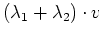
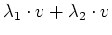
$\displaystyle (\lambda_1+\lambda_2)\cdot v$ $\displaystyle =$ $\displaystyle \lambda_1\cdot v + \lambda_2\cdot v$  
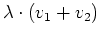
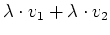
$\displaystyle \lambda\cdot(v_1+v_2)$ $\displaystyle =$ $\displaystyle \lambda\cdot v_1 + \lambda\cdot v_2$  
$\displaystyle (\lambda_1\cdot\lambda_2)\cdot v$ $\displaystyle =$ $\displaystyle \lambda_1\cdot(\lambda_2\cdot v)$  
$\displaystyle 1\cdot v$ $\displaystyle =$ $\displaystyle v\,.$  

If $ K=\mathbb{R}$ or $ K=\mathbb{C}$, then one speaks of a real or complex vectorspace, resp.

Note, that the plus stands for addition in $ V$ and for addition in $ K$. The same stands for the multiplication.

(Authors: App/Burkhardt/Kimmerle)

According to the definition the group axioms in particular hold true in vector spaces:

The properties required for vector spaces ensure that addition, subtraction and multiplication by scalars satisfy the usual calculation rules. So because of properties V1 and V2 we can factor out products of sums,

$\displaystyle \left( \sum_i \lambda_i \right) \left( \sum_j v_j \right)
=
\sum_i \sum_j \lambda_i v_j\,
,
$

where the dot for the multiplication by scalars is usually omitted. Furthermore the sign rules hold true:

$\displaystyle -(-v) = (-1)(-v) = v, \quad
- \left( \sum_i v_i \right) = \sum_i -v_i\,
.
$

(Authors: App/Burkhardt/Höllig)

The polynomials of degree $ \le n$

$\displaystyle p(x) = a_0 + a_1 x + \cdots + a_n x^n,\quad
a_i\in\mathbb{R}\,
,
$

form a real vector space, where addition and scalar multiplication are defined in a quite natural way:

$\displaystyle (p+q)(x) = p(x) + q(x),\quad
(\lambda\cdot p)(x) = \lambda p(x)\,.
$

The axioms can easily be verified.

Observe that the polynomials of degree $ n$, that is, the polynomials with $ a_n\ne0$, do not form a vector space. The sum of two such polynomials can be of reduced degree. For example we have

$\displaystyle (2x - x^2) + (3 + x^2) = 3 + 2x\,.
$

(Authors: App/Burkhardt/Höllig)

The real sequences $ (a_n)$ with $ n\in\mathbb{N}$ form an $ \mathbb{R}$-vector space with respect to the operations

$\displaystyle (a_n) + (b_n) = (a_n + b_n),\quad
\lambda\cdot (a_n) = (\lambda a_n)\,.
$

Demanding additional properties can destroy the vector space structure. The monotone sequences do not form a vector space, since the sum of monotone sequences is not necessarily monotone as the the following example shows:

$\displaystyle (4 n) + (-n^2)\,.
$

But boundedness would be an allowable property.
(Authors: App/Burkhardt/Höllig)

  automatically generated 4/21/2005