Mo logo [home] [lexicon] [problems] [tests] [courses] [auxiliaries] [notes] [staff] german flag

Mathematics-Online course: Linear Algebra - Analytic Geometry - Quadrics

Principal Axis Transformation


[previous page] [next page] [table of contents][page overview]

By coordinate transformation (rotation and translation) a quadric in $ \mathbb{R}^n$ can be brought to normal form:

$\displaystyle x^{\operatorname t}A x + 2 b^{\operatorname t}x + c =
\sum_{i=1}^m \lambda_i w_i^2 +
2\beta w_{m+1} + \gamma
\,,
$

where $ \beta\gamma=0$.

\includegraphics[width=\moimagesize]{a_hauptachsentrafo}

The columns of the rotation matrix $ U$ contain the eigenvectors $ u_i$ of $ A$ the directions of which are called principal axes.

(Authors: App/Burkhardt/Höllig)

For the symmetric matrix $ A$ there exists an orthonormal basis of eigenvectors $ u_i$, where the first eigenvectors belong to eigenvalues $ \lambda_i \ne 0$. After the first substitution $ x=Uy=(u_1,\ldots,u_n)y$ we obtain the diagonal form

$\displaystyle y^{\operatorname t}\operatorname{diag}(\lambda_1,
\ldots,\lambda_...
...
2(\underbrace{U^{\operatorname t}b}_{\tilde{b}})^{\operatorname t}y +
c
\,.
$

For $ \lambda_i \ne 0$ we can eliminate the linear terms by the substitution (completion of square)

$\displaystyle y_i = z_i - \tilde{b}_i/\lambda_i\,.
$

The constant changes as follows:

$\displaystyle c\to \gamma = c - \sum_{i=1} ^m
\tilde{b}_i^2 / \lambda_i
\,.
$

Hence, we obtain the form

$\displaystyle \sum_{i=1}^m \lambda_i z_i^2 +
\sum_{i=m+1}^n 2\tilde{b}_i z_i +\gamma\,.
$

If there exists $ \tilde{b}_i\ne 0$ with $ i\ge m+1$, then a further rotation, given by the vectors

$\displaystyle v_i$ $\displaystyle = z_i\,,\quad i\le m$    
$\displaystyle v_{m+1}$ $\displaystyle =(1/\beta)\sum_{m+1}^n \tilde{b}_i z_i\,,\quad\beta = \pm\vert\tilde{b}\vert$    

which are orthogonally completed by $ v_{m+2},\ldots,v_n$, yields

$\displaystyle \sum_{i=1}^m \lambda_i v_i^2 +
2\beta v_{m+1}+\gamma\,.
$

Here we choose the sign for $ \beta$ so that, after division by $ \beta$, there are at least as many positive terms as negative ones ( $ \lambda_i/\beta$).

The following translation

$\displaystyle w_{m+1}$ $\displaystyle = v_{m+1} +\gamma/(2\beta)$    
$\displaystyle w_i$ $\displaystyle = v_i\,,\quad i\ne m+1$    

eliminates the constant and yields

$\displaystyle \sum_{i=1}^m \lambda_i w_i^2 +
2\beta w_{m+1}\,.
$

(Authors: App/Burkhardt/Höllig)

The quadric

$\displaystyle Q:\quad 8x_1^2 + 17x_2^2 + 20x_3^2 + 20x_1x_2 + 8x_1x_3 + 28x_2x_3 - 48x_1 -
114x_2 - 78x_3 + 207 =0
$

is to be brought to normal form.

In terms of matrices we have

$\displaystyle Q:\quad x^{\operatorname t}A x + 2b^{\operatorname t}x + c =0
$

where

\begin{displaymath}
A=\left(
\begin{array}{ccc}
8 & 10 & 4\\
10 & 17 & 14\\
4 ...
...ht)\,,\quad b=(-24,-57,-39)^{\operatorname t}\,,\quad c=207\,.
\end{displaymath}

Matrix $ A$ has the eigenvalues $ 36$ , $ 9$ and 0 , corresponding normalized eigenvectors are, for example,

$\displaystyle u_1=\frac{1}{3}(1,2,2)^{\operatorname t}\,,\quad
u_2=\frac{1}{3}(2,1,-2)^{\operatorname t}\,,\quad
u_3=\frac{1}{3}(2,-2,1)^{\operatorname t}\,.
$

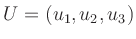
After transformation $ x=Uy$ with $ U=(u_1,u_2,u_3)$ we obtain

$\displaystyle Q:\quad 36y_1^2 + 9 y_2^2 - 144y_1 - 18y_2 + 18y_3 + 207 = 0\,.
$

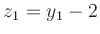
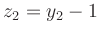
Completion of squares $ z_1=y_1-2$ , $ z_2=y_2-1$ , $ z_3=y_3$ yields

$\displaystyle Q:\quad 36z_1^2 + 9z_2^2 + 18z_3 + 54 = 0\,.
$

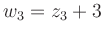
The translation $ w_1=z_1$ , $ w_2=z_2$ , $ w_3=z_3+3$ yields the normal form

$\displaystyle Q:\quad 36w_1^2 + 9w_2^2 + 18w_3 =0\,,
$

or after division by $ 9$

$\displaystyle Q:\quad 4w_1^2 + w_2^2 + 2w_3 =0\,.
$


  automatically generated 4/21/2005