
Mathematics-Online course: Linear Algebra - Analytic Geometry - Quadrics
|
|
[home] [lexicon] [problems] [tests] [courses] [auxiliaries] [notes] [staff] |
|
|
Mathematics-Online course: Linear Algebra - Analytic Geometry - Quadrics | ||
Quadratic Form | ||
| [previous page] [next page] | [table of contents][page overview] |
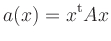
 the expression
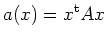
Dependent on the sign of the
eigenvalues of we distinguish
between three types:
 to be
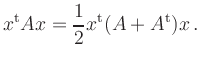
symmetric. For an arbitrary matrix the quadratic form
can be written as
to be
symmetric. For an arbitrary matrix the quadratic form
can be written as

Quadratic forms occur, for example, in the
Taylor expansion of a scalar function  :
:

 is the Hesse matrix
of the second partial derivatives. If has continuous
second partial derivatives this matrix is symmetric.
is the Hesse matrix
of the second partial derivatives. If has continuous
second partial derivatives this matrix is symmetric.
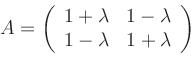
 and
and  .
.
Hence, the quadratic form
 , parabolic for
  and
hyperbolic for
and
hyperbolic for
 .
.
| automatically generated 4/21/2005 |