Mo logo [home] [lexicon] [problems] [tests] [courses] [auxiliaries] [notes] [staff] german flag

Mathematics-Online course: Linear Algebra - Analytic Geometry - Orthogonal Groups

Reflection


[previous page] [next page] [table of contents][page overview]

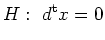
A reflection in $ \mathbb{R}^n$ with respect to the hyperplane orthogonal to unit vector $ d\ne 0$

$\displaystyle H:\ d^{\operatorname t}x = 0
$

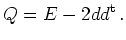
can be described by the following matrix:

$\displaystyle Q = E - 2 d d^{\operatorname t}\, .
$

\includegraphics[width=0.8\linewidth]{a_spiegelung}

(Authors: App/Burkhardt/Höllig)

$ Q$ is obviously symmetric, and, thus, we obtain

$\displaystyle Q^2 = (E-2dd^{\operatorname t})^2=E^2 - 4dd^{\operatorname t}+4dd^{\operatorname t}dd^{\operatorname t}=E\,,
$

that is, $ Q$ is orthogonal.

To prove the reflection property observe that vector

$\displaystyle x-Qx = x-x+2dd^{\operatorname t}x = 2 (d^{\operatorname t}x) d
$

is parallel to $ d$ and the midpoint between $ x$ and $ Qx$ lies in the hyperplane:

$\displaystyle \langle x+Qx,d\rangle= d^{\operatorname t}x + d^{\operatorname t}x - 2 d^{\operatorname t}dd^{\operatorname t}x
=0\,.
$

Thus, $ Qx$ is the reflection of $ x$ across the hyperplane orthogonal to $ d$ and passing through the origin.
(Authors: App/Burkhardt/Höllig)

  automatically generated 4/21/2005