Mo logo [home] [lexicon] [problems] [tests] [courses] [auxiliaries] [notes] [staff] german flag

Mathematics-Online course: Linear Algebra - Normal Forms - Singular Value Decomposition

Moore-Penrose Conditions


[previous page] [next page] [table of contents][page overview]

The pseudo inverse (Moore-Penrose inverse) $ A^+$ of an $ m\times n$-matrix $ A$ is uniquely determined by the following identities:
  1. $\displaystyle A A^+ A = A
$

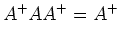
  2. $\displaystyle A^+ A A^+ = A^+
$

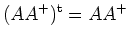
  3. $\displaystyle (A A^+)^{\operatorname t}= A A^+
$

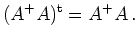
  4. $\displaystyle (A^+ A)^{\operatorname t}= A^+ A\,.
$

(Authors: App/Burkhardt/Höllig)

It can easily be verified that the pseudo inverse defined by

$\displaystyle A^+ = V S^+ U^{\operatorname t},\quad
A = U S V^{\operatorname t}
$

satisfies the given conditions. The first identity, for example, follows from

$\displaystyle (U S V^{\operatorname t})(V S^+ U^{\operatorname t})(U S V^{\operatorname t}) =
U [SS^+S] V^{\operatorname t}
\,,
$

since the product of the generalised diagonal matrices (in square brackets) is formed by multiplying the diagonal elements, and since, by definition,

$\displaystyle s^+_{i,i} = 1/s_{i,i},\quad i\le
\operatorname{Rg}(A)\,.
$

The other identities also follow by simple calculation.

However, to show that $ A^+$ is uniquely characterised by the given conditions is much more difficult.

(Authors: App/Burkhardt/Höllig)

  automatically generated 4/21/2005