Mo logo [home] [lexicon] [problems] [tests] [courses] [auxiliaries] [notes] [staff] german flag

Mathematics-Online course: Linear Algebra - Normal Forms - Singular Value Decomposition

Pseudo-Inverse


[previous page] [next page] [table of contents][page overview]

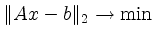
By means of the singular value decomposition $ USV^*$ of an $ m\times n$ matrix $ A$, the solution of the minimization problem $ \Vert Ax-b\Vert _2\to\min$ can be expressed in the form
$\displaystyle x = A^+b,\quad A^+ = VS^+U^*,
$

where $ A^+$ is the so-called pseudo-inverse of $ A$ (Moore-Penrose inverse), and $ S^+$ is an $ n\times m$ diagonal matrix of the form

$\displaystyle S^+ =\operatorname{diag}(1/s_1,\ldots,1/s_k,0,\ldots,0)\, ,
$

containing the inverse values of the singular ones.
Since the $ 2$ -norm is invariant under unitary transformations, we can multiply $ Ax-b$ from the left by $ U^*$ . With

$\displaystyle c=U^* b,\quad y=V^* x,
$

we obtain the equivalent minimization problem

$\displaystyle \Vert Sy-c\Vert _2 =
\left\Vert \left( \begin{array}{c}
s_1y_1-...
...k \\ -c_{k+1} \\ \vdots \\ -c_m
\end{array} \right) \right\Vert _2
\to\min.
$

We find the minimum by solving the first $ k$ equations:

$\displaystyle y_i=c_i/s_i,\ i=1:k\,
.
$

Since $ V$ is unitary, we have $ \Vert x\Vert _2 = \Vert y\Vert _2$ . Hence, for the solution of minimal norm

$\displaystyle y_{k+1}=\cdots=y_n=0\,
.
$

Summarizing, it follows that

\begin{displaymath}
y = S^+c,\quad
s^+_{i,j} =
\begin{cases}
1/s_i &
\text{for}\ i=j\le k; \\
0& \text{otherwise.}
\end{cases}
\end{displaymath}


We solve the least squares problem for

$\displaystyle A =
\left(\begin{array}{rrr}
2 & -4 & 5 \\ 6 & 0 & 3 \\
2 & -...
...quad
b =
\left(\begin{array}{r}
1 \\ 3 \\ -1 \\ 3
\end{array}\right)\,
.
$

In order to compute the singular value decomposition, we first determine the eigenvalues and eigenvectors of

$\displaystyle A^{\operatorname t}A =
\left(\begin{array}{rrr}
80 & -16 & 56 \\ -16 & 32 & -40
\\ 56 & -40 & 68
\end{array}\right)
$

and obtain

$\displaystyle s_1^2 = 144,\, s_2^2 = 36,\, s_3^2=0,\quad
V = \frac{1}{3}
\lef...
...{array}{rrr}
2 & 2 & -1 \\ -1 & 2 & 2 \\ 2 & -1 & 2
\end{array}\right)\,
.
$

This implies

$\displaystyle S =
\left(\begin{array}{rrr}
12 & 0 & 0 \\ 0 & 6 & 0 \\
0 & 0...
... & 0 \\ 6 & 3 & 0 \\
6 & -3 & 0 \\ 6 & 3 & 0
\end{array}\right)
= US\,
.
$

We obtain the first two columns of $ U$ by dividing the respective columns of $ AV$ by the corresponding singular values. (The resulting vectors must have norm 1.) We find the other columns (not uniquely determined) by completing the first two columns to an orthonormal basis:

$\displaystyle U = \frac{1}{2}
\left(\begin{array}{rrrr}
1 & -1 & -1 & 1 \\ 1 & 1 & -1 & -1 \\
1 & -1 & 1 & -1 \\ 1 & 1 & 1 & 1
\end{array}\right).
$

Thus, the pseudo-inverse (Moore-Penrose inverse) is

$\displaystyle A^+ =
V \left(\begin{array}{cccc}
\frac{1}{12} & 0 & 0 & 0 \\ 
...
...}
-2 & 6 & -2 & 6 \\ -5 & 3 & -5 & 3 \\
4 & 0 & 4 & 0
\end{array}\right),
$

and

$\displaystyle x = A^+b =
\frac{1}{4}\left(\begin{array}{c}
2 \\ 1 \\ 0\end{array}\right)
$

is the solution of minimal norm.
  automatically generated 4/21/2005

