Mo logo [home] [lexicon] [problems] [tests] [courses] [auxiliaries] [notes] [staff] german flag

Mathematics-Online course: Linear Algebra - Normal Forms - Singular Value Decomposition

Singular Value Decomposition


[previous page] [next page] [table of contents][page overview]

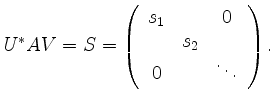
For any real $ m\times n$ matrix $ A$ there exist unitary matrices $ U$ and $ V$ with

$\displaystyle U^* A V = S =
\left(\begin{array}{ccc}
s_1 & & 0 \\
& s_2 & \\
0 & & \ddots
\end{array}\right).
$

The singular values

$\displaystyle s_1\ge s_2\ge\cdots\ge s_k>s_{k+1}=\cdots=0
$

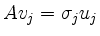
are the square roots of the eigenvalues of $ A^* A$, $ k$ is the rank of $ A$, and the columns of $ U$ and $ V$ are eigenvectors of $ AA^*$ and $ A^* A$, respectively. Moreover,

$\displaystyle Av_j = \sigma_j u_j
$

for $ 1\leq j \leq k$.

In the special case of a real matrix $ A$, the matrices $ U$ and $ V$ are orthogonal.


Diagonalizing the hermitian matrix $ A^* A$ we obtain

$\displaystyle V^* A^* A V =
 \operatorname{diag}(s_1^2,\ldots,s_k^2,0,\ldots,0) = S^{\operatorname t}S\,
 ,$ (1)

and we can assume that, beginning with the top left entry, the eigenvalues are arranged in descending order. Since $ A^* A$ is positive semi-definite, all eigenvalues are non-negative and can be interpreted as squares of non-negative real numbers which are used to define the $ m\times n$ diagonal matrix $ S$ .

From the above equation, it follows that the columns of $ AV$ are orthogonal and have norm $ s_i$ :

$\displaystyle AV =
\left(\begin{array}{ccc ccc}
s_1 u_1 & \cdots & s_k u_k
& 0 & \cdots & 0
\end{array}\right) =
US
$

with a unitary matrix $ U$ .

Having constructed the representation

$\displaystyle A= USV^* \ ,
$

we can easily verify the remaining assertions.

Since unitary transformations do not change the rank of a matrix, we have

$\displaystyle \operatorname{rank}\,A = \operatorname{rank}\,S = k\,.
$

Moreover, we have

$\displaystyle AA^* u_j = U(SS^{\operatorname t})U^* u_j = u_j (s_j)^2
$

and

$\displaystyle A^*Av_j = V(S^{\operatorname t}S) V^* v_j = v_j (s_j)^2\,.
$

Finally, $ Av_j$ equals the $ j$ -th column of $ US$ , i. e. $ u_js_j$ .


  automatically generated 4/21/2005