
Mathematics-Online course: Linear Algebra - Normal Forms - Diagonalisation
|
|
[home] [lexicon] [problems] [tests] [courses] [auxiliaries] [notes] [staff] |
|
|
Mathematics-Online course: Linear Algebra - Normal Forms - Diagonalisation | ||
Diagonal From of Hermitian Matrices | ||
| [previous page] [next page] | [table of contents][page overview] |
 of a hermitian matrix
 are real, and there
exists an ONB consisting of eigenvectors
are real, and there
exists an ONB consisting of eigenvectors  . Therefore
 diag
diag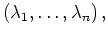
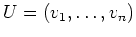 is an unitary matrix.
The special case of real symmetric matrices
 provides real eigenvalues.
| automatically generated 4/21/2005 |