
Mathematics-Online lexicon: Annotation to
|
|
[home] [lexicon] [problems] [tests] [courses] [auxiliaries] [notes] [staff] |
|
|
Mathematics-Online lexicon: Annotation to | ||
Implementation of the QR-Iteration | ||
| A B C D E F G H I J K L M N O P Q R S T U V W X Y Z | overview |
 of the tridiagonal
  -iteration
with shift
-iteration
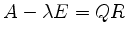
with shift  computes a sparsity preserving
-factorization,
computes a sparsity preserving
-factorization,

 based on the vector
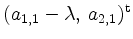 is applied
to rows one and two from the left and
is applied
to rows one and two from the left and  is applied to columns
one and two from the right. This destroys the tridiagonal form
of
is applied to columns
one and two from the right. This destroys the tridiagonal form
of  by introducing an entry in position
  . Now, Givens
rotations
. Now, Givens
rotations
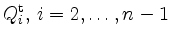 are
successively applied to rows
are
successively applied to rows  and
and  and their transposes
  to the corresponding columns:

 is based on the vector of the
current entries in positions
is based on the vector of the
current entries in positions
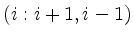 . Hence, the similarity
transformation with restores the tridiagonal form up to column
. Hence, the similarity
transformation with restores the tridiagonal form up to column  .
This process is illustrated schematically below.
.
This process is illustrated schematically below.
![$\displaystyle \left( \begin{array}{c}
{\mbox{\includegraphics[width=0.2\linewidth,bb=125 619 214 708,clip]{Num_18_2_Bild1}}}
\end{array}
\right)$](/inhalt/aussage/aussage1453/img19.png) |
![$\displaystyle \stackrel{Q_1}{\longrightarrow}
\left( \begin{array}{c}
{\mbox...
...8,clip]{Num_18_2_Bild2}}}
\end{array} \right)
\stackrel{Q_2}{\longrightarrow}$](/inhalt/aussage/aussage1453/img20.png) |
|
![$\displaystyle \left( \begin{array}{c}
{\mbox{\includegraphics[width=0.2\linewidth,bb=125 619 214 708,clip]{Num_18_2_Bild3}}}
\end{array}
\right)$](/inhalt/aussage/aussage1453/img21.png) |
![$\displaystyle \stackrel{Q_3}{\longrightarrow}
\left( \begin{array}{c}
{\mbox...
...214 708,clip]{Num_18_2_Bild4}}}
\end{array}
\right)
\longrightarrow \cdots$](/inhalt/aussage/aussage1453/img22.png) |
We have indicated modifications in the entries with different symbols. Moreover, we have highlighted the entries which determine the subsequent Givens rotation. This transformation annihilates the entry in the circled position.
If, accidentally, both entries in position
are zero, the -th
transformation can be omitted. In this case, the off-diagonal entry
 is zero and the dimension of the eigenvalue problem can be reduced.
| automatisch erstellt am 19. 8. 2013 |