
Mo logo [home] [lexicon] [problems] [tests] [courses] [auxiliaries] [notes] [staff] german flag

Mathematik-Online lexicon: Annotation to

Rational Functions of Matrices


A B C D E F G H I J K L M N O P Q R S T U V W X Y Z overview

If eigenvalue $ \lambda$ of matrix $ A$ is not a pole of a given rational function
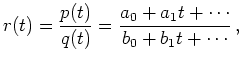
$\displaystyle r(t) = \frac{p(t)}{q(t)} =
\frac{a_0 + a_1 t + \cdots}{b_0 + b_1 t + \cdots}
\,,
$

then $ r(\lambda)$ is a eigenvalue of

$\displaystyle r(A) = q(A)^{-1} p(A) = p(A) q(A)^{-1}
\,.
$

In particular, $ \lambda^k$ is an eigenvalue of matrix power $ A^{k}$ and, provided that $ A$ is invertible, $ 1/\lambda$ is an eigenvalue of $ A^{-1}$.
Let $ A v = \lambda v$ and $ k\ge0$, then $ A^k v = \lambda^k v$, and, more generally,

$\displaystyle \left(\sum_k c_k A^k\right) v =
\left(\sum_k c_k \lambda^k\right) v
\,.
$

Further we have

$\displaystyle A v = \lambda v
\Leftrightarrow
v = \lambda A^{-1} v\,,
$

if $ A$ is invertible.

If $ \lambda$ is not a zero of the polynomial in the denominator $ q$, then we have

$\displaystyle q(A) v = q(\lambda) v,\quad
q(A)^{-1} v = q(\lambda)^{-1} v\,,
$

consequently,

$\displaystyle q(A)^{-1} p(A) v =
q(\lambda)^{-1} p(\lambda) v =
p(A) q(A)^{-1} v
$

as asserted.
(Authors: Burkhardt/Höllig/Hörner )

[Back]

  automatisch erstellt am 8.  7. 2004
